Monday, October 23

God is in the Details and in Fruitcake too.

“God is in the details” is a phrase that I heard over and over while in college. It is a quote attributed to Mies van der Rohe, the German born American architect who helped define the clean minimalist spaces of modern architecture in the twentieth century. While I never cared much for his style, I whole heartedly appreciate his assertion that details matter. They absolutely do. I admit I feel a little embarrassed to seemingly contradict myself on the matter. Time and time again I have written posts which flagrantly espouse an exuberant, unrestrained throw-it-together attitude towards cooking which appear as though all good sense and attention have abandoned me forever. There are definitely times that I am on the cusp, the wild edge of dangerous tomfoolery. But usually, I feel the inner quiet calm of a cook who understands the parameters of her kitchen and the ingredients which reside within it. I have spent years observing and quantifying the minutia of my surrounding environment. Part of what was drilled into my education, was how to see, how to keep looking, sifting through different lenses in order to understand the greater whole. Literally a detail can make all the difference between something that compels or repels, whether a salad, a sentence or a song.

In the kitchen, it is fun to experiment with an ingredient, explore its range and consequently re-interpret it. I am a student of food, forever taken by the many faces of it, so much that occasionally while daydreaming a whole personality and scenario might emerge out of something as mundane as a loaf of bread. Recently while looking at a photo of a sweet blushing cake demure in a shower of powder white sugar and topped with a single ruby rose, I imagined this charming confection to be the embodiment of Ivonne its creator over at Creampuffs in Venice. The thought evolved into a question between the two of us: What kind of dessert would best personify you?

The first response might be to utter the name of one’s favorite dessert, but that is not necessarily the same thing, although supposedly we are what we eat. Almost immediately two portraits come to mind: Croquembouche- a highly stylized pyramid of cream puffs bedecked in dramatic flourishes of nougat and spun sugar or Fruitcake- deep, dark and mysterious jeweled from within, a little going a long way. I admit that Croquembouche appeals to the inner fantastical me, the side that dreams of parading around in dramatic brocade period pieces and wig or donning on a native costume embellished with winking abalone shells, tightly anchored rows of hummingbird feathers and a necklace of porcupine quills. But the vision doesn’t make the translation to outer reality; there is no walk on the wild side for me. Far too practical minded, I decorate my drama with restraint. Which brings me to fruitcake and believe me, I know how that sounds. You see I had a fruitcake conversion about three years ago, climbing my way up from hermit cookies to pfeffernusse, from Pannetone to Panforte.
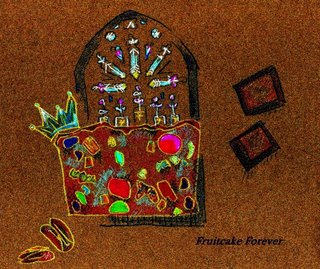
J_ was making a groom’s cake in honor of her niece’s upcoming marriage. The plan was to make a traditional English dark fruitcake to give away as wedding favors to the attendees. I heard about this wonderful recipe which served over one hundred people, the special deep hatbox shaped pan the cake was baked in, the precise way to slice an individual serving and parcel it up for gifting. It seemed like a lot of work, one year in advance. Time to age and improve it-- or so the plan was. A drunken bevy of fruit was made. Instead of a few cups of brandy, two bottles were used, the fruit macerating silly for months. Brilliant I thought, cheering her on from the side lines of my home. I really didn’t hear about the cake for months while it ripened in dark secrecy, until it was time for the unveiling and partitioning. What I remember later about that conversation was a lot of frustrated hand gestures and fragmented sentences conveying bungled up geometry. Essentially one is trying to get the most slightly-bigger-than-a-matchbox slivers out of a deep form. After a lot of effort, the cake was cut into pretty packages and what remained was a mountain of crumby bits. Apparently the long soak drove the moisture content up and the cake lost its structural integrity. Though only morsels they represented much more in time, effort and cost. With that she salvaged the remains gathering them up into plum sized nuggets and enrobed the sweetmeats in dark chocolate. This was my re-introduction to fruitcake and it was ambrosial. Since then I have been haunted by the taste. It had a depth, richness and complexity that lingered on the tongue and crept up into my nasal cavities, perfuming me from within with spice and warmth and goodness.

Fruitcake is beautifully strong on the outside. It possesses a simple uncluttered line whether brick like loaf or high waisted ring. (Generally) It doesn’t go-to-pieces when cut, leaving a messy residue of crumbs behind. A slice is a vision to behold, stained glass mosaic revealing an inner sanctum of bounty and grace. I secretly wonder if in addition to incense, frankincense and myrrh, the three wise men came bearing fruitcake to the newborn King. The cake is the proverbial horn of plenty, treasure trove of riches, a storehouse of goodness. No wonder men of God busy themselves in the production of this sacred food. Historically it has been suggested that it was made after harvest time in gratitude, eaten to celebrate and bless the next year’s crop. I can appreciate the fact that these cakes were used in ceremony and that they are made to last, merging the practical with the symbolic. It also has been said that Queen Victoria only ate this high calorie, well preserved decadently rich treat once a year upon her birthday. She believed this restraint showed the proper amount of good taste. While a touch on the prudish side, I can still relate.

The cake is a colorful map of time and place. It is a citizen of the world with a collection of ingredients hailing from all over: Medjool dates from Morocco, Turkish sultanas and apricots, pecans from Texas, Sri Lankan cinnamon and cognac from France. The recipe and process are both simple and direct, yet allow for spontaneous customization. I resonate with a process that can be done in slow meditative fashion- the lengthy accumulation of ingredients, the shelling and roasting of nuts, the slicing of dried/candied fruit, the soak in good spirits, and the long low bake in the oven. Still yet, the good cake is drizzled again with more liquor and set away to cure and improve with age. The transformation once complete allows all disparate parts to meld and softly underscore each other creating a sweet that is sophisticated yet down-to-earth, spiced without being frenzied, bold yet subtly subdued and truly something of heaven and earth. Eaten as refreshment with some bracing black tea, dark chocolate dipped fruitcake reminds me of how splendid and bounteous life can be.

And how about you, what kind of dessert would you be?

Ivonne at Cream Puffs in Venice, Lis at La Mia Cucina and Gattina at Gattina

Wednesday, October 18

Soup is Good Food

I instantly liked Blondine. She had once been a foreign exchange student living with my boyfriend’s family years before in rural upstate New York. An atypical teenager, she spent a number of her younger years contemplating joining a convent. At the point that I met her university life was winning the debate and she sought residence within the un-cloistered pulsating heart of Paris. I was twenty-one, traveling to meet her for the first time with our mutual friend during fall break Rome semester. Years later I attribute my love and laissez-faire attitude towards soup making on one memorable dinner with this gamine jeune fille and on being young and romantic. First, Blondine drove an utterly fashionable black and maroon Citroën 2CV. Even a complete automobile ignoramus such as me was able to grasp how wondrous this highly delineated driving machine was. Debonair and elegant, residing somewhere between an old fashioned baby carriage, a patent leather saddle shoe and a vintage Louis Vuitton trunk, we sped around Paris in her slightly bruised vehicle. She made home within a dark claustrophobic apartment perched atop a treacherous stack of stairs and her kitchen, a cluttered corner was barely an afterthought in this wreck of a building. Yet my eyes didn’t hone in on those kinds of details, after all we were in France tearing at fresh baked baguette, drinking cheap wine and dining on soup.

By the dimly lit glow of a cubicle which she called her icebox, Blondine pulled out item after item of food out of this unimaginably small receptacle. Next she found a battered soup pot fit to feed a small army and set it upon an impossibly narrow stove top space. Tap water filled until pot half full, fire on and mysterious ingredients chopped and thrown—uninitiated, I discovered that this was how soup was born. I admit that at certain points within this flurry of activity I was concerned for the direction this dinner was going. The appearance and freshness of the contents were to my estimation, in question. For example I believe that I witnessed a partially eaten ham sandwich quartered and diced as well as a semi limp head of leaf lettuce make its final resting place deep within that cavernous pot. I felt too shy to directly inquire into these sightings and pocketed the entire experience as my first introduction to exotic French cooking. Blondine confidently selected a soupçon of this and sniffed at that, explaining that she had learned the art of soup at the capable hands of her mother. While the pot bubbled merrily away I watched as every vestige of recognizable food was erased in the hungry aftermath of an immersion stick blender. My education was complete once I lapped up thick confetti-speckled spoonfuls of this soulful mélange and sopped butter smeared bread hunks within the diminishing puddle at the bottom of my bowl. At once I understood how every distinct element softened and melded with each other, the sum greater than the individual parts. Watching Blondine cook was liberating. She had such an easy way to her that directly translated over into her “au pif” (oh-peef, meaning intuitive by the nose) cooking style. She was accessible and open minded, thrifty, creative and above all, natural. From then on I have been unstoppable, at times down right brazen with my tureen. There is no telling what curious ingredient might make its appearance within my soup bowl.

The making of soup is a joyous expression. I see it as an affirmation of life and community. First of all, it is difficult to suppress soup to serve just two. Not impossible, just highly unlikely. After all look at the size of most soup pots. One wouldn’t think to conduct a symphony of flavors in a pond of broth within the limiting confines of a saucepan. Also the meditative rhythmic motion of cutting and chopping lulls a person and opens them up, expansive and generous to create a meal for sharing. In the sleepy late afternoon hours I have woken up to piles of vegetables that have magically proliferated upon my cutting board wanting to create more. I think we remember our primordial selves, young and buoyant within our amniotic homes when we taste the first drops of saline liquor. That may be why we cherish this food aqueous, warm and comforting, related to our very own vital fluids and offer it as nourishment and remedy to our closest friends and family.

I have been thinking about the story of Stone Soup, the old world morality tale about greed and poverty, sharing and the creation of relationships that feeds. The peddler with his vision and imagination is able to bring forth hearty soup out of scarcity, from the rubble and dross of ordinary life, from a common rock. Through the spinning of dream and story the soup is brought to life as each villager contributes an ingredient for the soup, a bit of cabbage, a few potatoes, some salt pork and a carrot or two. When I was younger the tale spoke to me about the abundant creation that occurs as a by-product of sharing. In the story the items given are a treasured stash. As I have aged and been seasoned by a dose or two of my own unsavory experiences, I now see those items as equally eligible ingredients for the soup. With that, I too dream up an extraordinary meal by using my nose and inner vision to tease out, to wonder and to transform leftover ham sandwich into soup for a queen.
In the spirit of the post I thought of Mulligatawny Soup or Indian Chicken Soup. I no longer remember the original recipe and have created so many versions that I now assume that it is quite another thing altogether. Truly this is the bringing together of an odd ragtag group that I rallied from my refrigerator- but I assure you the results were delicious. Just to make sure I was not living in my own little fantasy world, which in other circumstances I think fine, I spooned a bit into my friend’s mouth. I believe she approved.
Mulligatawny Soup au Pif

1 small delicata squash deseeded and chopped into ½ “pieces
1 smallish fennel bulb chopped roughly the same
½ slightly wizened onion, chopped
1/3 bunch of chicory chopped
1 small mealy apple, cored and chopped
1 ½ cup sauerkraut soaked in cold water for about 15 minutes and drained
1/2 jalapeno deseeded and chopped fine
Spoonful of Better than Bouillon- Chicken
2 chicken breasts chopped into bite size chunks
Water
1 Full Tablespoon of Curry
1 cup of coconut milk
1 bunch of cilantro chopped

Directions: On medium-high fire sauté first seven ingredients with a bit of oil until softened and taking on some color, about 15 minutes. Throw in enough water to cover chopped items by about 1-2”. Add chicken flavoring and curry and cook another 10 minutes on medium low and covered. Throw in the chicken, stir and continue to cook until veggies are tender and chicken is thoroughly cooked. Stir in coconut milk and cilantro and turn the fire off. One can substitute juice of one half to one lemon instead of the sauerkraut. I too like to toss in a good handful of red lentils at the point that I add the water.

Monday, October 9

In de Pekel Zitten

I am in a pickle, “in de pekel zitten” which in Dutch means, sitting in the salty solution of fermenting vegetables. It’s not a pretty picture. Actually days of brilliant fall have been cascading by, dropping splashes of color throughout New England. People come from all over to revel in the glorious display of fiery brilliance and for the most part, I have been enjoying the scenic beauty along with the other leaf worshipers. Simultaneously however I am soaking in brine, a long and slow steep.

Early summer, I first began investigating these plucky eyebrow raising bites as lively accoutrements to celebratory fare. By late July I began throwing raisins devil-may-care into vats of vinegar and then I discovered addictive sweet pickles which enlivened my mouth with a scream of jalapeno. A jar of kimchi that had long taken residence in the far corners of my refrigerator, tang-ed just right became steady companion on many an uninspired night of leftovers. But most recently, I have been taken over by juicy exuberant sauerkraut. It has been years since I thought of the pungent matter, wet sloppy shreds of acidic translucent cabbage, ubiquitous side to a fat greasy sausage. Then out of nowhere I bought a bag of kraut probably to accompany said fat greasy kielbasa and now-- I cannot seem to dine without it. I find myself eating straggles of the pickled slaw on salads and sandwiches, strewn through a heaped up hedge of cooked greens. I have even consumed it alongside spoonfuls of cottage cheese and like Pavlov’s dog the mere thought of the sour kraut gets my saliva flowing.

Believing in the vast intelligence of the body and the communication that exists between our inner and outer worlds, I take my sudden craving for kraut seriously, well semi seriously anyways. While stoic boulders of cabbage command a certain kind of solemn respect, they are sulfurous and somewhat antiquated like a formal bust sitting within a poorly lit drawing room. Pickles are funny, seriously funny too. Fermented foods have been around since ancient times. Various civilizations used this preservation process as a means to improve the digestibility of foods, raise the nutritional value, prevent spoilage and alter taste and texture. Somewhere along the way food has been lost and found, discovered in various stages of break down and transformation. These happy accidents proved to be delicious and in time the environments were recreated and refined to create even more desirable flavors. Whether thousand year old Chinese eggs, buried Icelandic rotting shark, caves of Roquefort cheese or Korean hot and spicy pickled cabbage, every culture seems to have their own beloved interpretation of fermented food. Sour bites of food have a way of drawing the juices out of us, riling us up. They tug at our appetites as evident in various foods that precede and accompany a meal: wine and beer, cheese, pickles and chutneys, olives and pickled herring, even catsup. Tart, brisk, salty, pungent foods excite the palate and senses. They can wake us up. But like a good slap in the face or whiff of smelling salts, the bracing flavors can also bring us back down to earth and into our bodies.

Being in a pickle or maybe more appropriately sitting in the brine is synonymous with being in a difficult situation. While stewing and macerating within a salty solution doesn’t sound terribly inviting. It isn’t all bad. My college professor used to say that he welcomed the awkward intersection between two worlds and that the creative response was discovered within the “in between space”. The saline solution nurtures an invisible world of microbes. Suspended within this unseen world is a relationship that feeds and creates waste, composts and then ultimately regenerates. In this microcosmic galaxy creation abounds, culture giving rise to more culture. Perhaps the best advice I can think of if one is “in de pekel zitten” is to hold on tight and …pass the sauerkraut.